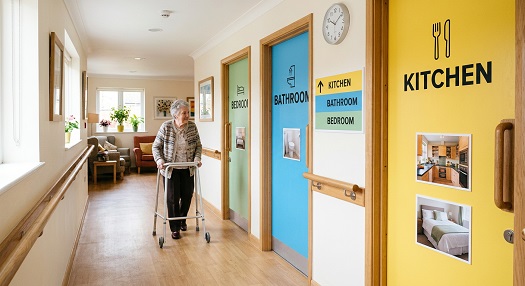
Using color coding helps individuals with dementia navigate their surroundings by relying on high-contrast visual cues to identify rooms, highlight essential items, and reduce environmental confusion. Applying distinct colors to specific daily areas allows individuals to safely move through their homes while maintaining a greater sense of independence.
How Does Color Coding Enhance Spatial Awareness in Dementia Care?
Color coding enhances spatial awareness by giving the brain immediate visual information that’s easier to process than complex written signs or verbal directions. Individuals experiencing cognitive decline often retain their ability to recognize bold colors long after other cognitive functions change.
- Creates clear boundaries between different living spaces
- Reduces anxiety by making the environment feel predictable
- Helps individuals locate personal spaces like bedrooms or bathrooms without frustration
Which Colors Are Most Effective for Dementia Navigation?
The most effective colors for dementia navigation are primary colors like red, blue, and yellow because aging eyes and cognitive changes often make pastel or muted tones difficult to distinguish. Warm colors tend to draw attention, while cool colors can create a calming atmosphere.
- Red – Highly visible and excellent for highlighting important areas or eating spaces
- Yellow – Bright and cheerful, often used to draw attention to specific doors or handrails
- Blue – Calming and distinct, frequently utilized to designate resting areas or bedrooms
How Can Caregivers Use Color Contrast to Highlight Essential Items
Caregivers can use color contrast by placing light-colored objects against dark backgrounds or vice versa to ensure essential items stand out clearly. Because depth perception often decreases with dementia, contrasting colors prevent important objects from blending into the surrounding environment.
- Place a brightly colored toilet seat on a white toilet bowl.
- Use dark plates on a light tablecloth so food is easily visible.
- Paint the bathroom door a completely different color than the hallway walls.
One of the most challenging tasks of helping an elderly relative age in place safely and comfortably is researching agencies that provide the best Tucson senior home care. You can turn to Home Care Assistance for reliable, high-quality in-home care for aging adults. We offer 24-hour live-in care for seniors who require extensive assistance, and we also offer respite care for family caregivers who need a break from their caregiving duties.
What Environmental Hazards Can Color Coding Hide or Disguise?
Color coding can disguise environmental hazards by painting them the exact same color as the surrounding walls or floors, effectively camouflaging them from sight. This strategy prevents individuals from interacting with potentially unsafe areas without causing the distress of a locked door or physical barrier.
- Paint exit doors the same color as the hallway walls to reduce wandering.
- Match the color of utility closet doorknobs to the door itself.
- Use dark-colored rugs in front of off-limits areas, as dark patches are often perceived as holes to be avoided.
The cognitive challenges that accompany dementia often leave aging adults unable to manage everyday tasks, which puts their safety and health at risk. Certain age-related conditions can make it more challenging for seniors to age in place safely and comfortably, but 24-hour home care experts are available around the clock to help Tucson seniors manage their health. Whether your loved one is living with dementia or recovering from a stroke, you can trust the professional 24-hour caregivers from Home Care Assistance to enhance his or her quality of life.
Aging in place can present a few challenges for seniors living with dementia. However, with the help of professional Tucson dementia home care, older adults can still live independently at home. Families can rely on Home Care Assistance to provide their elderly loved ones with mental and social stimulation, timely medication reminders, assistance with meal prep, and much more. Our caregivers are available around the clock to help your loved one live a happier and healthier life. For more information about our flexible, customizable home care plans, call one of our compassionate Care Managers today.
Frequently Asked Questions
How do changes in vision affect individuals with dementia?
+
Individuals with dementia often experience reduced depth perception, decreased color sensitivity, and narrowing of their visual fields. These changes make it difficult to navigate spaces that lack high color contrast.
Can color coding replace traditional signage in a home?
+
Yes, color coding often works better than traditional signage because processing text requires more cognitive effort. However, combining a distinct color with a simple picture provides the most effective navigational cue.
Why is it important to avoid busy patterns on floors and walls?
+
Busy patterns can look like moving objects, steps, or obstacles to someone with dementia, causing fear and confusion. Solid contrasting colors provide a stable visual field that promotes safe movement.
Is there a specific color that causes distress in dementia?
+
While reactions vary, heavily saturated dark colors or excessive use of stark white can sometimes cause anxiety or glare. It’s best to observe your loved one’s reaction to specific colors and adjust the environment accordingly.